Showing posts with label staff. Show all posts

Thursday, February 26, 2015

Turtles, Sharks and Owls


Are you are a Turtle, a Shark, a Teddy Bear, a Fox or an Owl when it comes to dealing with conflict?  I was at a course the other day where these conflict types were discussed and I found it a really interesting concept (you can read another post about the other things I learnt here).  I learnt a lot about conflict, the types of ways people deal with it and how to help students to learn to work through it in a positive way.  All good stuff.

The animals associated with how people instinctively deal with conflict:

Turtle - quiet, retreats from conflict by withdrawing and refusing to talk about the issue.  The turtle avoids conflict at all costs.  They tend to stay away from conflict and avoid the people they have conflicts with.

Shark - aggressive, 'my way or the highway'.  Sharks do not shy away from conflict.  Instead they try to force their opinion or way onto the person they are in conflict with.  They are determined to 'win' and like to compete.

Teddy Bear - does what is expected of them to avoid conflict.  They accommodate and make sacrifices to keep harmony.  A Teddy Bear tries to smooth things over and will put others before themselves in an attempt to preserve their relationships.

Fox - makes compromises, negotiates.  They give a little to get a little.  They are willing to sacrifice and maintain balance for the greater good.  Foxes do not avoid conflict but also don't seek to fully resolve the issue to the satisfaction of both parties.

Owl - comes to solutions that suit both parties, reasons, remains calm.  Owls are collaborative and place great value on goals and relationships.  They like to problem solve and work through a conflict fully to make sure that all parties are satisfied with the outcome.

The point of discussing the conflict types at the course wasn't to decide on which way of dealing with conflict was 'better' but more to allow people to realise the positives and negatives of the way that they operate in a situation where conflict in involved.  Depending on the situation, a person who has developed good conflict management skills may choose to behave in any of the conflict styles to get the outcome that is desired.

As a side note for those of you who read my Maker Time post, Miss Four was looking at her 'cake' earlier and as she was rummaging around in it found a M n M chocolate.  I cannot hazard a guess as to how long it was in there for or what it was touching (a dead cicada or lump of gravel perhaps).  It was promptly eaten.  Awesome.

Reference must be made to the Cool Schools Mediation programme where I heard this information, it is however, written in my own words and I do not claim any ownership over the concept.

Saturday, February 21, 2015

The One About Ants


Ants are fascinating creatures.  They are much like us, incredibly social creatures living in groups of such order and organisation.  Intelligent and intuitive.  Hardworking.  Always busy.  You might not be able to pick them out in the photo above that I took earlier today but they are there.  I was watching a game of rugby and looked down at the ground.  Everywhere I looked there were ants.  And thus tonight's post was born (amazing where you can find inspiration!).

As I watched the little creatures scuttling furiously from place to place I thought of how an entire world was right down by my feet and I could hardly see it.  I looked closer and saw them changing direction, ducking into holes and under grass, carrying things.  They were busy, very busy indeed.  But unless I looked down, directly down, really hard I would never have see them.

I started thinking about how our schools and workplaces can be like this.  Everyone working furiously, often undetected or noticed unless someone looks hard enough to see what's actually there.  People who have jobs to do, hundreds of small (or large) tasks to complete, places to go and things to achieve.  

My school is very much like the ants.  We are a small group of dedicated educators who work so very hard.  We constantly push ourselves and each other to be better practitioners, to become more knowledgeable and skilled.  We all have jobs to do, often completing these jobs without the awareness of others.  Quietly going about our hundreds of tasks which make the school run seamlessly, smoothly.  

Unless you are a teacher you often don't realise the work that goes into moulding the next generation into successful learners.  Parents often joke about how it must be the greatest job in the world (and it is, don't get me wrong) because of all the weekends and holidays we have off.  Yeah right I hear you all laugh.  Teachers are the hardest working group of anyone I know.  People outside of the education field can be forgiven for making such judgements.  Just as we don't realise the importance of each of the ants in their scurrying madness at our feet.  Each job or task making the colony run like clockwork.  

So to all the teachers, Principals, educators out there...  this post has been about the ants... and about us.  Keep up the amazing work.  Even if no one sees it.  It is all worth it, our kids are worth it.

Here are a couple of really cool facts I found about ants tonight (courtesy of http://antark.net/)...
  • Ants worst enemies are not humans, but other ants (much like us humans being our own worst enemies!).
  • Ants have two stomachs - one for food for themselves, one for food for others (kind of gross but sweet at the same time).
  • Dozens of colonies of the world's smallest ant could live in the brain case of the world's largest ant (not sure how I feel about this - sounds like a horror movie theme if you ask me).
  • The total weight of all the ants in the world is the same as, if not larger than the weight of all the humans in the world (fearing a takeover anyone??).


Friday, February 20, 2015

Be Inspired, I Am


My brain is feeling a little tired tonight.  More than a little inspired though.  I attended my very first educamp today.  #educamprotovegas.  A room of such amazing talent.  I was so inspired.

A network of professional learning partners - in the form of Twitter, or face-to-face - is so incredibly powerful.  Such power to change, to motivate, to support, to learn.  There is truly nothing else that comes close.

I put my hand up at the end of last year to run our region's Year 4-8 Teachers PLN.  It's a little daunting, but I'm also dreadfully excited.  I ran this same group a couple of years ago and hadn't yet experienced the power and beauty of a great PLN, but this time will be different.  Connecting with my neighbouring colleagues is something I've always been passionate about.  We share a common catchment of students, experience a lot of the same hardships, challenges, celebrations and successes.  Who better to meet with on a regular basis and hash things out?  What untapped talent is lurking just below the surface in our group?  I am dying to find out.

Attending #educamprotovegas today gave me a lot of ideas of how to establish, support and grow this PLN baby, to nurture it into a strong connected group of like-minded educators with a passion for making a difference and collaborating for the goal of student success.  Top of my to-do list is providing a warm and inviting environment for us to meet in - my classroom (best I get tidying!!), establishing a sense of mutual trust and respect, giving opportunities for everyone to share (or to just listen if that is what they need), good food (a must-have in my book!) and hot coffee.  It will be our first meeting of the year and I want everyone to leave the room as I left educamp today... wanting more.

More connectedness, more learning, more collaboration.  More.

Did I mention that I was excited?  Inspired?  I am.

As a side note... to all those I met today face-to-face at #educamprotovegas - you inspire me daily on Twitter and you have now inspired me in real life.  I was in awe of the talent and sheer passion that exuded from the room.  Thank you.

Tuesday, February 17, 2015

Pipeline Leadership

Cyber Goth Chick Pipes

Teachers are like most professionals in other vocations.  They want to grow throughout the course of their career in education.  This might be in formal leadership positions or in skill and knowledge - both admirable aspirations.  Teachers often want to stay at their current school but are not given the opportunities to grow as leaders or broaden their skill set in a way that fulfils their desire to move ahead with their career .  How many teachers do you know of that have moved onto other positions within new schools because their career aspirations or opportunities to advance are not addressed?

Pipeline Leadership is a model for growing the people you have within your organisation into the leaders you will need in the future.  We have such untapped talent in many of our schools.  Do we really know what our teachers aspire to?  Where they see their future in education?  Initiatives such as ACET here in New Zealand are trying to provide some recognition and incentive for teachers who are excelling in their careers to remain in the classroom, at the coalface in front of our greatest asset - our children.

Pipeline Leadership minimises the need to look outside of ourselves for new leaders, instead growing the skills and knowledge base within the staff already in the school, providing a firm platform for future growth and leadership.  Effective Principals recognise the need for advancing student achievement and hand-in-hand seek to cultivate the leadership talents of their teachers.  Building leadership teams, ensuring a meaningful delegation of responsibility and developing future school leaders have to be the most effective ways of managing a school effectively (http://www.newleaders.org).  

The Pipeline Leadership model seeks to develop leadership skills at every level in an organisation which means that the knowledge and mindset required to lead at the next level is successfully developed in the people moving forward into new leadership roles.

How might this work in a school setting?  What sorts of conversations and Professional Learning opportunities would we be seeing if we were seeking to develop the leadership talents from within?  What feedback and feedforward would be given freely out?  How would we be supporting and mentoring each other?

I will leave you with a quote from Tom Peters:
Embedded image permalink


Sunday, February 15, 2015

Ladders Not Ceilings


I was lucky enough to watch the leadership team from Summerland Primary School in action at ULearn14. They talked about some very powerful stuff. One thing that really struck a chord with me was that you need to give teachers a ladder, not a ceiling.

In an environment where we encourage students to reach for the stars, that anything and everything is possible - how often do we allow our teachers the same open space to really fly as professionals?

A previous Principal of mine used to say that we were not to get too far ahead of everyone else on the teaching staff (mainly in the digital arena) or else we'd have the snap back effect. He likened it to a bungee cord that we were running away with, there was only so much stretch before the cord was too tight and either snapped or we would be jerked back where the others were. I didn't like this.

So I wasn't allowed to stretch myself for fear of getting too far ahead? I wasn't allowed to push myself to new heights because others weren't ready? This didn't sit well with me. Tall Poppy Syndrome for adults.

University of Canterbury researcher Louise Tapper thinks we have an unhealthy tall poppy chopping culture here in New Zealand. She says "Expectations in New Zealand are that we want people to be the same, rather than excel". We all know that we need to stop having those expectations with our children, but what about with our teachers?

By placing rules and restrictions around people you also create a ceiling for people who could have been better. People who could have pushed through and created amazing things if they were allowed to, encouraged to even. We need to chip away at the practices that create the bungee cord in the first place and allow for ladders for people to climb up past the ceiling. To grow into what they could be. To soar and become the very best they can be.  

What else could you aspire to if you were given the chance? The scope to believe that anything and everything was possible? We give the stars and sky to our students to reach for, let's start giving it to our teachers.

I'll finish with a quote from Ben Young (New Zealand Herald - November 11, 2009). He says "Success is a hard road to follow, it alone is going to naturally select winners and losers. Why should we make it even harder? Or worse knock out natural leaders at a young age? Shouldn't our aim be to maximise the amount of people rising their head above the rest? And in turn create a pool of tall poppies? In a global knowledge economy this is a big win".

Coffee Time


I walked up town the other day to get lunch.  It's a small town.  There are a ridiculous number of cafes for the number of people that live here but it's on the main road, tourists are everywhere.  And the coffee is to die for.  I am rather spoilt, I know that.

Our school receptionist walked in after me and sat down at table outside.  She seemed preoccupied.  Didn't appear to notice me there.  I waited for my order to be ready and touched her shoulder as I walked past her.  Said she could have sat with me if she wanted company.  She looked up and sheepishly said 'I just needed a break'.  She seemed embarrassed, like she was confessing to something she shouldn't be doing.  She said she had been planning to take her order back to school but then changed her mind.  She needed a break.  I get that completely.

A school is pure madness a lot of the time.  Rooms filled to the brim with little voices chattering away incessantly, meeting after meeting, talking to colleagues, communicating with parents.  Even the photocopier is noisy.  The phone never stops ringing.  There is often little time to gather one's thoughts.  To think in a quiet space.  To breathe, just breathe.  To have a break.

I've found working in a little town amazing.  It's got the rural feel with some urban conveniences.  Coffee is one.  Possibly my most favourite one (who am I kidding, of course it is).  Stepping out of school for a few minutes and walking up the street to get a cup of coffee or grabbing lunch is pure bliss.  I don't even feel guilty for it.  I need it.  We all need it - a break.  Take it in any form you can, a walk around the far end of the field.  Sit in the quiet library or between the dusty shelves of the resource room.  Play an instrument.  Or lock your classroom doors, turn the air con on and just breathe for a few moments.  I've done all of the above.

In this busy, busy world we all need to take a break sometimes.  The reward is feeling more centred, relaxed, like you recharge just enough to get through the next hour (or six - sometimes the only time to snatch that break is first thing in the morning!).  It's important.  Do it.

As a side note for those readers who understand why my blog is named Half Cold Coffee - no I do not usually finish the cup before it gets cold, yes it sits there half finished for a while, and I'll let you in on a little secret... add a half shot of caramel and then once it's cold it tastes like a caramel/coffee milkshake.  You're welcome :-)

Wednesday, February 11, 2015

Reframing the Loss


Change.  It's everywhere.  I found this quote by Deepak Chopra and it really reasonated with me.  All great changes are preceded by chaos.  It reminded me of something I heard last year that changed the way I feel about change.  And the way I deal with others going through it.

Last year I was lucky enough to attend ULearn14 with my colleagues.  It was an experience like no other I've been to in my teaching career.  I happened to stumble upon a really amazing speaker.  His name was Mark Osborne and after I heard him speak, the first time by accident, I went and changed sessions I had already booked to see him two more times during the three day conference.  He spoke a lot about change.  And it changed me.

There are two types of responses to change.  First Order Change and Second Order Change.  Depending on the situation people will fall into either category or some combination of both.  As leaders we need to be aware of these differences and receptive and responsive to both.  We need to have built positive relationships with our staff so that when these changes occur we are able to help each other through them and come out a stronger team on the other side.

Change is difficult.  Sometimes overwhelmingly so.  People often have a lot to lose when something changes and this is extremely hard.  A leader needs to recognise the response to change and to give the person what they need to get through it.

First Order Change is a when a person is learning something new and is open to the change but needs help in managing it.  It might be the addition of new technology into their classroom such as iPads or the change from PCs to laptops.  People going through this type of change need manuals, checklists and helpful tips to get them used to the change and embrace it.  This kind of change is relatively simple.  Just provide the scaffolding and support.  Done.

Second Order Change is harder.  Much harder.  It often occurs when a current framework is changed, perhaps something like moving from a paper system of management to a paperless one, bringing in BYOD in a deviceless school or completely changing the year level that a teacher has always taught in.  A person going through this type of change will feel threatened, scared, or like there is no-way possible that they will be able to manage this new 'normal'.  This response requires kindness, support, a listening ear, reassurance.  There needs to be trust and a supportive relationship to get through this change successfully.

When I think about the times in my teaching career when someone has really dug their toes in about something, I am left convinced that they were going through Second Order Change.  When I think about how I could have helped them more, I wish I had known the things I know now.  While I, or some of my other colleagues, may have needed a manual or a quick demo to learn the new skill, the toe-digger probably needed someone to talk to about how scary this was for them, someone to give them reassurance and guide them gently and patiently through.  Toe-diggers are often seen as saboteurs or dissenters of new ideas.  They are often given the same manual as the rest of the team and told to get on with it.  How well does this really work.  Is the change embraced?  The person left motivated and inspired?  In my past experience, no.

The next time you see a colleague digging their toes in, ask yourself if they have something to lose, if the change is actually overwhelmingly scary and big for them.  Ask them how they are feeling about it and listen between the lines.  Take them out for a coffee.  Build your relationship.  Give them reassurance and offer to guide them through.  You might be surprised how the response changes.  I dare you.

Thanks to Mark Osborne (@mosborne01) for introducing this idea to me, for helping me to learn how to help others through change.  

Tuesday, February 10, 2015

Positive Playgrounds


Today I set about making a positive change to the playground culture in my school.  It wasn't anything out of the ordinary, or even inventive.  It was stock-standard, run-of-the-mill stuff.  But it will make a difference.

The positive change I made today?  I sat down with our three oldest classrooms of students and taught them all the same rules to a game.  I explained to the students that problems in the playground often boil down to someone thinking that something is not fair and then reacting to that feeling in an angry way.  The person probably doesn't deem it fair because there is a misinterpretation of the rules of the game.  The students nodded in agreement.

Together we discussed the rules, debated a few of the trickier ones, drew diagrams and checked that we all understood what was expected of us when we played this game.  Heading outside the oldest students modelled the game for the younger ones, taking the game slowly, being careful to be honest and to be fair.  We then all jumped onto the field, the mixed age groups working alongside each other in a positive way to practice the game.  And then we actually played it.

You see, not rocket science, not reinventing the wheel.  Just stock-standard, run-of-the-mill stuff.  But it works.

Making positive changes to playground culture starts with the basics.

  • Letting the students have a say in creating the rules. 
  • Making sure that all students understand how to play the games that are available to them in the playground.
  • Discussing ways to deal with each other respectfully when a disagreement arises.  Practising this.
  • Meeting regularly with students to talk about playground issues and how to minimise these.  The students know the answers.  They just need a voice.
We don't need to reinvent the wheel, we don't need to have a degree in rocket science.  We just need to do the basics well.  Repeat the steps often.  Keep talking to our kids.  Make that positive change to playground culture.


Monday, February 9, 2015

Adapting Our Practice


Adults are slow learners.  Not all the time but there are definitely moments, as teachers, when we sure are.

In the classroom we often hear teachers figuratively banging their head against the proverbial brick wall when a student cannot grasp a concept or a piece of knowledge that they have told them over and over again.  It's not the child.  They are not the slow learner here.

Adapting our practice is paramount to student success.  Changing the status quo in order to find the missing puzzle piece for a child should be foremost in our teachers' minds as they contemplate why a student isn't achieving success, or what they can do to make a difference to how a student learns.  For teachers this can mean stepping out of their comfort zone, onto some unidentifiable twig thin branch.  Walking a tightrope between what we are used to and the unknown realm of possibility.

How often do we teach as we like to be taught, in ways that we understand, on topics that we find interesting?  Adapting our practice means learning to let go of this.  Stepping into the unknown and out into the uncertain.  Trying new things.  Asking a new set of questions from an endless ocean of answers.  Being brave.

If we are to truly nurture a child to their full potential the go-to proverbial brick wall needs to come down.  Our head banging needs to become head-scratching, solution-searching.  We need to "fail fast, and fix it fast" (a quote I have used in a previous post and still cannot find the rightful owner to give credit to!).  Our teachers need to develop a growth mindset and to continually push forward into the great expanse of that-which-is-not-yet-known to seek pathways that may lead to success for our students.

We ask our students to be brave in their learning.  We need to expect it of our teachers too.

Saturday, February 7, 2015

Pencil Personalities


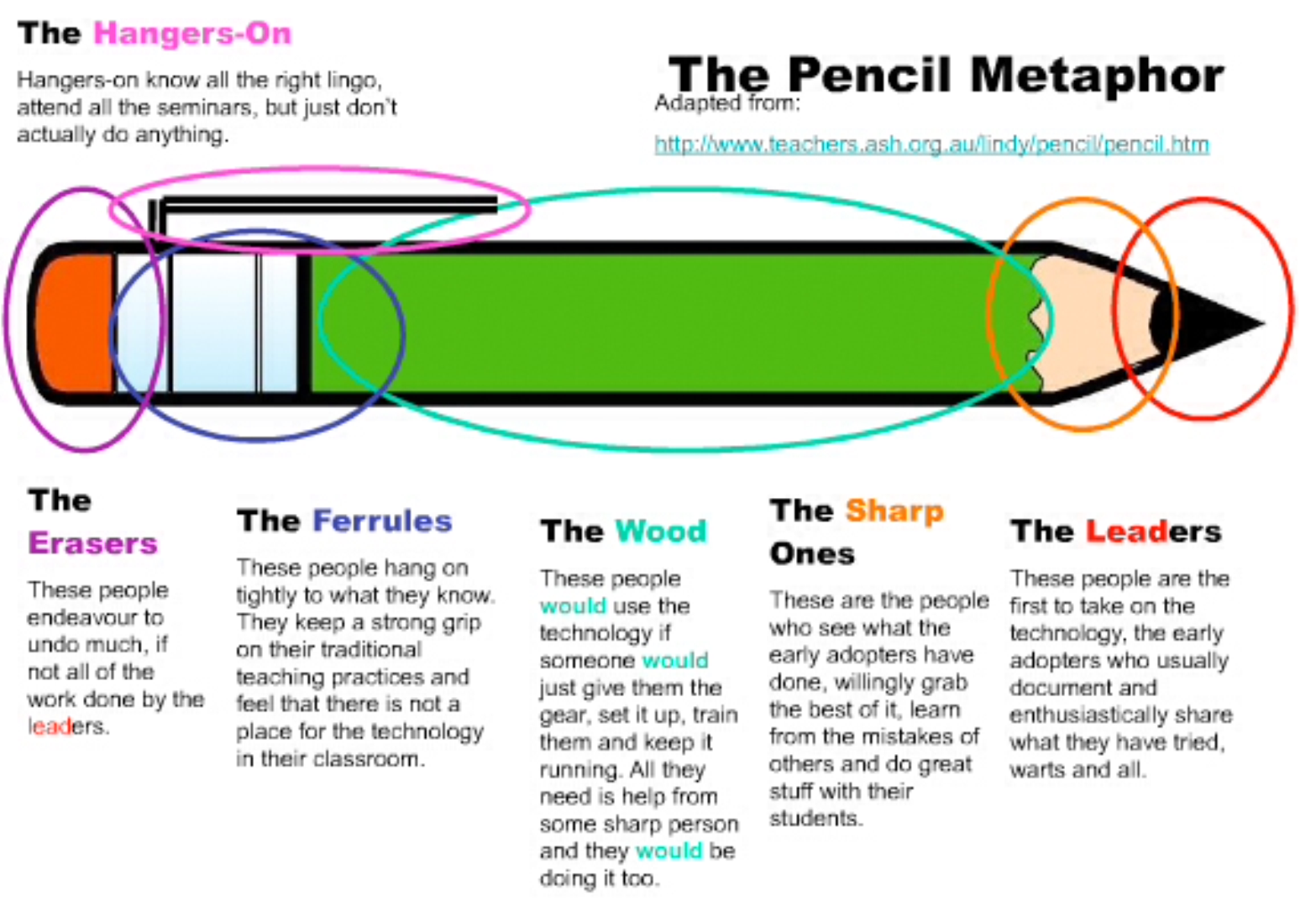
We all have them in our schools.  The Pencil Personalities.  I'm not sure who crafted this nifty little image but it was based on one from www.teachers.ash.org.au.  I love it.  Hopefully the image is clear enough to read but I will attempt to explain the Pencil Metaphor in more detail below.

First we have the Leaders.  These are the driving force behind change in our schools.  The people who take the bull by the horns and jump in feet first when something new and technologically exciting comes along.  At the 'pointy end of things' as my old Principal used to say.

The Sharp Ones watch carefully to see what the early adopters have done with the technology, they take the best parts, learn from their mistakes and put lots of effort into making sure that their students have the best opportunities available to them.  The Leaders and Sharp Ones are the visionaries in your school.  They need support and time to try new things in a safe environment.  They also need time to focus and consolidate new knowledge and practices before charging onto the next adventure.  A good leader will provide the scope for these people to be creative and enthusiastic but also keep a little tension on the reigns so that they don't end up miles and miles ahead of everyone else thus creating a divide in your staff.

The Wood.  I like this one.  They would use the technology if someone would set them up with it, give them training and keep the programmes running for them.  These are the people who like to think they walk the talk, but really things would fall over if there wasn't someone in the background managing it for them.  The Wood people are usually going through first-order change, they need manuals, step-by-step instructions to help them through the change it's not so much scary as it is work.

The Ferrules are people who grasp tightly onto what they've always done.  They don't really like change and believe that traditional practice serves our students just fine thank you.

The Erasers are those people in your school who like to erase or undo the hard work done by the Leaders.  They are the ones who are stuck-in-the-mud, who don't like change because they have something to lose from changing.  They like to sabotage attempts to develop modern teaching practices and introduce new technology.  The Ferrules and Erasers have something to lose by changing from the status quo.  They are going through second-order change and need a lot of emotional support to help guide them through what to them is a scary experience.

And... the Hangers-On.  These people mean well, they like to attend Professional Development sessions and learn all the latest lingo so they can talk about it, but they never actually do anything with it.  These people need to be motivated.  They need to know the purpose and outcomes for the change.  They need a reason to want to make the leap from talking about the change to actually diving in and doing it.

So... the Pencil Personalities.  They are out there in our schools.  We all fit into one of the categories.  As leaders we need to manage the variety of personalities on our staff and help to guide everyone towards the greater goal of best practice, and provide the best opportunities for our students.

Which Pencil Personality are you??